How Can Britain Become a Superpower Again

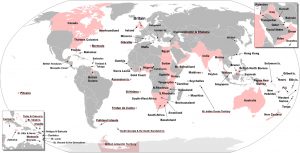
The British Empire stood in the way. Non until the late 1950s did the Usa finally get a superpower.
By Dr. Derek Leebaert / 11.18.2018
Professor of History
Georgetown Academy
A oft repeated tale about the twentieth century is this: At the end of World War Ii, the British Empire was too weak and too dispirited to continue as a global imperial power; thus a confidently prosperous, well-armed America assumed leadership of the West—and did so while creating a U.South.-led international gild that we've lived with ever since. Just it's all a myth. Instead, the Americans ran smack into an Anglo-Saxon colossus whose war-hardened leaders wouldn't step aside for anyone, allow alone serve as junior partners.
Not until December 1956 would the newly-reelected Eisenhower assistants assert what it called a "proclamation of independence" from British authority, and information technology did so among a world order just taking course. Every bit Richard Nixon recalled, simply and so did the Us explicitly take over "the strange policy leadership of the free world." At that point, Geoffrey Crowther, longtime editor of theEconomist, would finally admit that "Britain is no longer a Super-power."
Today, as the globe faces some other time of historic geopolitical adjustment, it's vital to sympathise what occurred during the dozen years later on WWII when history's largest empire battled to maintain its continuing against an utterly novel course of global preeminence that loomed from beyond the Atlantic.
The British Empire and Commonwealth, after all, was the very definition of a "super power" when that term was coined in 1944 to categorize nations that possessed "great powerplussmashing mobility of ability." The empire was planetary, with deep relationships nearly everywhere, including those of underground intelligence equally well as a trading and currency regime which covered one-half the globe. Britain drew upon statecraft and experience that—as many U.Due south. officials, businesspeople, and generals believed—outweighed any nation'southward.
With the state of war'due south end, neither the Soviet Union nor the United states fully met that definition of "superpower." The Soviet Spousal relationship was the near massive unitary state ability ever, even so it lacked overseas reach, except through spying and subversion. The United States was by far the world's strongest nation, with an atomic monopoly and unprecedented industrial weight. But it was still a resolutely afar super-state, hesitant to presume a commanding political and military machine position. It took years to accept the need to garrison GIs in Europe and Asia, to develop a naval presence in the Persian Gulf, and to build an intelligence capability that offered more than than amateurish adventuring.
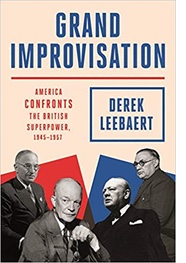
Britain, in turn, was hardly "bankrupt" after WWII, as the myth as it. It retained a strong industrial base; its two great trading rivals, Germany and Japan, had been destroyed, and everyone expected that the huge American loan of December 1945 would provide a span to total and rapid recovery. In fact, Britain's industrial productivity boomed beyond what anyone had imagined. To be sure, the searing balance of payments crises of 1947 and 1949 and 1952 threatened to pull down Britain's economy by stifling merchandise, only even those dramas proved manageable as Britain led the world in jet aviation, life sciences, and civil atomic power—unquestionably the industries of tomorrow.
Meanwhile, the American press wrote of the Empire and Republic deploying "a million men in a thousand garrisons worldwide."
New materials show the British Empire's importance to United states policymakers and as well the extent to which postwar dealings were confrontational. For instance, we now know that Foreign Role manipulations bluffed the Americans to intervene in Greece's ceremonious war during 1947, bringing along the Truman Doctrine. In fact, the British were escalating in Greece.
By July 1950, when the United States was at war in Korea, President Harry Truman received a pivotal summit-secret document:National Security Council Report 75, British Military Commitments. Historians take never seen it. In 50-seven tight pages, NSC 75 concludes that the British Empire hadn't retreated a whit since 1945, in dissimilarity to decentralizing and adjusting, equally in India and Palestine; that information technology was unlikely to retreat at all in the foreseeable future; and, in any event, that it would be incommunicable for the Us to replace the empire as a forcefulness of global stability. US views inverse surprisingly slowly.
When Dwight Eisenhower became president in 1953, he acknowledged not merely that U.k. was dominant in the Middle East, equally it was throughout this era, only likewise that information technology wielded a veto over U.S. decisions in Southeast Asia. United kingdom was a nuclear weapon state that possessed the strongest conventional forces in Western Europe. And, every bit is as well known from new materials, information technology took much longer than has been believed for the CIA to overshadow MI6, United kingdom'due south Underground intelligence Service.
Altogether, these dozen years were a time when top U.S. officials believed that America's "biggest postal service-war difficulty"—perhaps more than the Soviet threat—was the inability to say no to the British Empire. In outcome, serious people in Washington ended that "no adequate foreign policy" was available to the United states if information technology weren't aligned with its sprawling, problematic marry. Eisenhower was, for the time being, candid in his sensation that global military ambitions, forth with the attendant political involvements, were alien to the The states.
Yet frustrations accumulated in Washington—non least, over myopic British policies toward Egypt, culminating in the British/French/Israeli invasion of November 1956 at Suez.
The break point finally came in October 1957, when Russian federation launched the kickoff Sputnik, a satellite propelled by an intercontinental ballistic missile that one time and for all stripped America of its isle security. Any happened, it was apparent that only the United states and the Soviet Union could compete at this level.
Americans, moreover, were gripped by dread that they would non be able to catch up. The were primed for the telephone call of John F. Kennedy, the magnetic young senator from Massachusetts, who was presently to thrill the nation as he evoked "a struggle for supremacy" against Moscow'due south "ruthless, godless tyranny." We have been driven by such dangerous zeal until today, when a new array of irrevocable decisions presses upon us.
Originally published by History News Network, reprinted with permission for educational, non-commercial purposes.
Comments
Source: https://brewminate.com/the-emergence-of-the-united-states-as-a-superpower-after-world-war-ii/
0 Response to "How Can Britain Become a Superpower Again"
Enviar um comentário