Ben Davis National Museum of Women in the Arts
| Angela Davis | |
|---|---|
 Davis in 2014 | |
| Born | Angela Yvonne Davis (1944-01-26) January 26, 1944 Birmingham, Alabama, U.S. |
| Occupation |
|
| Party |
|
| Spouse(s) | Hilton Braithwaite (m. 1980; div. 1983) |
| Partner(southward) | Gina Paring |
| Awards | Lenin Peace Prize |
| Academic background | |
| Teaching | Brandeis University (BA) Academy of California, San Diego (MA) Humboldt University (PhD) |
| Doctoral counselor | Herbert Marcuse |
| Academic work | |
| Discipline |
|
| Institutions |
|
Angela Yvonne Davis (built-in Jan 26, 1944) is an American political activist, philosopher, academic, scholar, and author. She is a professor at the University of California, Santa Cruz. A feminist and a Marxist, Davis was a longtime member of the Communist Party USA (CPUSA) and is a founding member of the Committees of Correspondence for Democracy and Socialism (CCDS). She is the author of over ten books on grade, gender, race, and the Usa prison house system.
Born to an African-American family in Birmingham, Alabama, Davis studied French at Brandeis University and philosophy at the University of Frankfurt in West Federal republic of germany. Studying under the philosopher Herbert Marcuse, a prominent figure in the Frankfurt Schoolhouse, Davis became increasingly engaged in far-left politics. Returning to the United States, she studied at the Academy of California, San Diego, before moving to Due east Federal republic of germany, where she completed a doctorate at the Humboldt University of Berlin. After returning to the Us, she joined the Communist Party and became involved in numerous causes, including the 2nd-wave feminist movement and the campaign against the Vietnam War. In 1969, she was hired every bit an acting assistant professor of philosophy at the Academy of California, Los Angeles (UCLA). UCLA's governing Board of Regents soon fired her due to her Communist Party membership; after a courtroom ruled this illegal, the university fired her again, this time for her use of inflammatory language.
In 1970, guns belonging to Davis were used in an armed takeover of a courtroom in Marin County, California, in which four people were killed. Prosecuted for three capital felonies, including conspiracy to murder, she was held in jail for over a twelvemonth before existence acquitted of all charges in 1972. She visited Eastern Bloc countries in the 1970s and, during the 1980s, was twice the Communist Party'south candidate for vice president; at the fourth dimension, she also held the position of professor of ethnic studies at San Francisco State Academy. Much of her piece of work focused on the abolition of prisons and in 1997, she co-founded Disquisitional Resistance, an organization working to abolish the prison–industrial complex. In 1991, among the dissolution of the Soviet Wedlock, she was part of a faction in the Communist Party that bankrupt away to establish the Committees of Correspondence for Democracy and Socialism. Also in 1991, she joined the feminist studies section at the University of California, Santa Cruz, where she became department director before retiring in 2008. Since then she has continued to write and remained agile in movements such as Occupy and the Boycott, Divestment and Sanctions entrada.
Davis has received various awards, including the Soviet Union'due south Lenin Peace Prize. Accused of supporting political violence, she has sustained criticism from the highest levels of the US authorities. She has also been criticized for supporting the Soviet Wedlock and its satellites.[three] Davis has been inducted into the National Women's Hall of Fame.[four] In 2020, she was listed equally the 1971 "Woman of the Year" in Time magazine'southward "100 Women of the Year" edition, which selected iconic women over the 100 years since women'south suffrage in the United States of America from 1920.[v] In 2020, she was included on Time 's list of the 100 most influential people in the world.[six]
Early on life [edit]
Angela Davis was born on Jan 26, 1944,[7] in Birmingham, Alabama. Her family lived in the "Dynamite Hill" neighborhood, which was marked in the 1950s by the bombings of houses in an effort to intimidate and drive out middle-class blackness people who had moved there. Davis occasionally spent time on her uncle'south farm and with friends in New York Metropolis.[8] Her siblings include two brothers, Ben and Reginald, and a sister, Fania. Ben played defensive back for the Cleveland Browns and Detroit Lions in the late 1960s and early on 1970s.[9]
Davis attended Carrie A. Tuggle School, a segregated black simple school, and later, Parker Annex, a middle-school branch of Parker High Schoolhouse in Birmingham. During this fourth dimension, Davis'southward mother, Sallye Bong Davis, was a national officer and leading organizer of the Southern Negro Youth Congress, an organization influenced past the Communist Political party aimed at building alliances amid African Americans in the South. Davis grew upwards surrounded by communist organizers and thinkers, who significantly influenced her intellectual evolution.[10] Among them was the Southern Negro Youth Congress official Louis E. Burnham, whose daughter Margaret Burnham was Davis'south friend from childhood, likewise every bit her co-counsel during Davis'southward 1971 trial for murder and kidnapping.[11]

Davis as a x-year-old Girl Scout in Birmingham, Alabama, the place from which, she says, "my political involvement stems"
Davis was involved in her church youth grouping equally a child, and attended Lord's day schoolhouse regularly. She attributes much of her political interest to her involvement with the Girl Scouts of the U.s.a. of America. She also participated in the Girl Scouts 1959 national roundup in Colorado. As a Girl Scout, she marched and picketed to protestation racial segregation in Birmingham.[12]
Past her inferior twelvemonth of high schoolhouse, Davis had been accepted by an American Friends Service Commission (Quaker) program that placed black students from the Southward in integrated schools in the North. She chose Elisabeth Irwin High Schoolhouse in Greenwich Village. There she was recruited by a communist youth group, Advance.[xiii]
Education [edit]
Brandeis University [edit]
Davis was awarded a scholarship to Brandeis University in Waltham, Massachusetts, where she was one of 3 black students in her class. She encountered the Frankfurt School philosopher Herbert Marcuse at a rally during the Cuban Missile Crisis and became his student. In a 2007 telly interview, Davis said, "Herbert Marcuse taught me that it was possible to exist an academic, an activist, a scholar, and a revolutionary."[fourteen] She worked part-fourth dimension to earn plenty money to travel to French republic and Switzerland and attended the eighth Globe Festival of Youth and Students in Helsinki. She returned dwelling in 1963 to a Federal Agency of Investigation interview about her attendance at the communist-sponsored festival.[15]
During her 2nd yr at Brandeis, Davis decided to major in French and continued her intensive study of philosopher and writer Jean-Paul Sartre. She was accepted by the Hamilton College Junior Twelvemonth in France Program. Classes were initially at Biarritz and later at the Sorbonne. In Paris, she and other students lived with a French family. She was in Biarritz when she learned of the 1963 Birmingham church bombing, committed past members of the Ku Klux Klan, in which four blackness girls were killed. She grieved deeply every bit she was personally acquainted with the victims.[15]
While completing her degree in French, Davis realized that her primary expanse of interest was philosophy. She was particularly interested in Marcuse's ideas. On returning to Brandeis, she sat in on his course. She wrote in her autobiography that Marcuse was approachable and helpful. She began making plans to attend the University of Frankfurt for graduate work in philosophy. In 1965, she graduated magna cum laude, a member of Phi Beta Kappa.[15]
University of Frankfurt [edit]
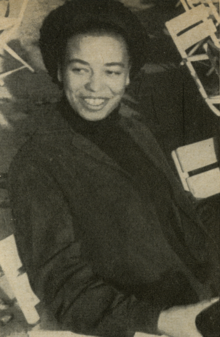
As a pupil at the Institute of Social Research at Goethe Academy in Frankfurt, Germany. Davis studied the work of philosophers Kant, Hegel, and Adorno.
In Germany, with a monthly stipend of $100, she lived first with a German family and later with a group of students in a loft in an quondam manufacturing plant. Later on visiting Eastward Berlin during the almanac May Day celebration, she felt that the East German authorities was dealing better with the residual effects of fascism than were the Westward Germans. Many of her roommates were active in the radical Socialist German Student Union (SDS), and Davis participated in some SDS actions. Events in the United States, including the formation of the Black Panther Party and the transformation of Student Nonviolent Analogous Committee (SNCC) to an all-black organization, drew her interest upon her return.[15]
Postgraduate work [edit]
Marcuse had moved to a position at the University of California, San Diego, and Davis followed him in that location afterwards her ii years in Frankfurt.[fifteen] Davis traveled to London to nourish a conference on "The Dialectics of Liberation". The black contingent at the conference included the Trinidadian-American Stokely Carmichael and the British Michael X. Although moved by Carmichael'due south rhetoric, Davis was reportedly disappointed by her colleagues' black nationalist sentiments and their rejection of communism as a "white human being's thing".[16]
She joined the Che-Lumumba Club, an all-black branch of the Communist Party United states of america named for revolutionaries Che Guevara and Patrice Lumumba, of Cuba and Congo, respectively.[17]
Davis earned a master's degree from the University of California, San Diego, in 1968.[18] She earned a doctorate in philosophy at the Humboldt University in Eastward Berlin.[xix]
Professor at University of California, Los Angeles, 1969–70 [edit]

Commencement in 1969, Davis was an acting assistant professor in the philosophy department at the University of California, Los Angeles (UCLA). Although both Princeton and Swarthmore had tried to recruit her, she opted for UCLA because of its urban location.[20] At that fourth dimension she was known as a radical feminist and activist, a member of the Communist Party USA, and an affiliate of the Los Angeles chapter of the Blackness Panther Party.[21] [22]
In 1969, the University of California initiated a policy against hiring Communists.[23] At their September 19, 1969, meeting, the Board of Regents fired Davis from her $10,000-a-yr mail considering of her membership in the Communist Party,[24] urged on by California Governor and futurity president Ronald Reagan.[25] Guess Jerry Pacht ruled the Regents could not fire Davis solely considering of her affiliation with the Communist Political party, and she resumed her post.[24] [26] The Regents fired Davis again on June 20, 1970, for the "inflammatory language" she had used in 4 different speeches. The report stated, "Nosotros deem particularly offensive such utterances as her argument that the regents 'killed, brutalized (and) murdered' the People'southward Park demonstrators, and her repeated characterizations of the police equally 'pigs'".[27] [28] [29] The American Clan of Academy Professors censured the board for this action.[26]
Arrest and trial [edit]
Davis was a supporter of the Soledad Brothers, three inmates who were accused and charged with the killing of a prison house guard at Soledad Prison.[30]
On Baronial 7, 1970, heavily armed 17-year-sometime African-American loftier-school pupil Jonathan Jackson, whose brother was George Jackson, one of the three Soledad Brothers, gained command of a courtroom in Marin Canton, California. He armed the blackness defendants and took Gauge Harold Haley, the prosecutor, and 3 female person jurors every bit hostages.[31] [32] As Jackson transported the hostages and 2 black defendants away from the courtroom, 1 of the defendants, James McClain, shot at the law. The police force returned fire. The judge and the three black men were killed in the melee; i of the jurors and the prosecutor were injured. Although the estimate was shot in the head with a nail from a shotgun, he also suffered a breast wound from a bullet that may have been fired from outside the van. Bear witness during the trial showed that either could have been fatal.[33] Davis had purchased several of the firearms Jackson used in the assail,[34] including the shotgun used to shoot Haley, which she bought at a San Francisco pawn store two days before the incident.[32] [35] She was also constitute to have been corresponding with one of the inmates involved.[36]

As California considers "all persons concerned in the commission of a crime, ... whether they directly commit the act constituting the law-breaking, or aid and advocate in its commission, ... are principals in any law-breaking and then committed", Davis was charged with "aggravated kidnapping and offset degree murder in the decease of Judge Harold Haley", and Marin County Superior Court Judge Peter Allen Smith issued a warrant for her abort. Hours after the estimate issued the warrant on August 14, 1970, a massive attempt to find and arrest Davis began. On August eighteen, four days after the warrant was issued, the FBI director J. Edgar Hoover listed Davis on the FBI's 10 Most Wanted Avoiding List; she was the third woman and the 309th person to be listed.[31] [37]

Davis wanted by the FBI on a federal warrant issued August 15, 1970, for kidnapping and murder.
Soon afterwards, Davis became a fugitive and fled California. According to her autobiography, during this time she hid in friends' homes and moved at night. On October thirteen, 1970, FBI agents found her at a Howard Johnson Motor Lodge in New York Metropolis.[38] President Richard Yard. Nixon congratulated the FBI on its "capture of the dangerous terrorist Angela Davis."[39]
On Jan v, 1971, Davis appeared at Marin County Superior Court and alleged her innocence before the courtroom and nation: "I now declare publicly before the court, before the people of this country that I am innocent of all charges which have been leveled against me past the state of California." John Abt, general counsel of the Communist Party USA, was one of the starting time attorneys to represent Davis for her alleged interest in the shootings.[11]
While being held in the Women's Detention Center, Davis was initially segregated from other prisoners, in lone confinement. With the assistance of her legal team, she obtained a federal court order to become out of the segregated expanse.[40]

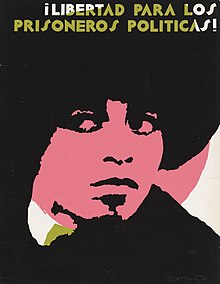
1971 poster by Rupert García urging freedom for political prisoners and depicting Angela Davis
Across the nation, thousands of people began organizing a movement to proceeds her release. In New York Urban center, black writers formed a committee called the Black People in Defence force of Angela Davis. By February 1971 more than than 200 local committees in the United States, and 67 in foreign countries, worked to complimentary Davis from jail. John Lennon and Yoko Ono contributed to this campaign with the song "Angela".[41] In 1972, subsequently a 16-calendar month incarceration, the land allowed her release on bail from canton jail.[31] On February 23, 1972, Rodger McAfee, a dairy farmer from Fresno, California, paid her $100,000 bail with the help of Steve Sparacino, a wealthy business owner. The United Presbyterian Church paid some of her legal defense force expenses.[31] [42]
A defense motility for a change of venue was granted, and the trial was moved to Santa Clara County. On June four, 1972, later on 13 hours of deliberations,[33] the all-white jury returned a verdict of not guilty.[43] The fact that she owned the guns used in the crime was judged insufficient to establish her role in the plot. She was represented past Leo Branton Jr., who hired psychologists to help the defense determine who in the jury pool might favor their arguments, a technique that has since become more than common. He also hired experts to discredit the reliability of bystander accounts.[44]
Other activities in the 1970s [edit]
Cuba [edit]
After her acquittal, Davis went on an international speaking tour in 1972 and the tour included Cuba, where she had previously been received by Fidel Castro in 1969 as a member of a Communist Party delegation.[45] Robert F. Williams, Huey Newton, Stokely Carmichael had also visited Cuba, and Assata Shakur afterwards moved there after escaping from a Us prison. Her reception by Afro-Cubans at a mass rally was so enthusiastic that she was reportedly barely able to speak.[46] Davis perceived Cuba equally a racism-free country, which led her to believe that "only under socialism could the fight confronting racism be successfully executed." When she returned to the Us, her socialist leanings increasingly influenced her understanding of race struggles.[47] In 1974, she attended the Second Congress of the Federation of Cuban Women.[45]
Soviet Union [edit]

In 1971, the CIA estimated that five per centum of Soviet propaganda efforts were directed towards the Angela Davis campaign.[48] In Baronial 1972, Davis visited the USSR at the invitation of the Fundamental Committee, and received an honorary doctorate from Moscow Country Academy.[49]
On May 1, 1979, she was awarded the Lenin Peace Prize from the Soviet Spousal relationship.[50] She visited Moscow later that calendar month to have the prize, where she praised "the glorious proper name" of Lenin and the "cracking October Revolution".[51]
East Frg [edit]
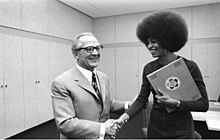
The East German government organized an extensive entrada on behalf of Davis.[52] In September 1972, Davis visited East Germany, where she met the state'southward leader Erich Honecker, received an honorary degree from the University of Leipzig and the Star of People's Friendship from Walter Ulbricht. On September 11 in East Berlin she delivered a speech, "Non Only My Victory", praising the GDR and USSR and denouncing American racism, and visited the Berlin Wall, where she laid flowers at the memorial for Reinhold Huhn (an Eastward German guard who had been killed past a man who was trying to escape with his family across the edge in 1962). Davis said "Nosotros mourn the deaths of the edge guards who sacrificed their lives for the protection of their socialist homeland" and "When nosotros return to the Us, we shall undertake to tell our people the truth about the true function of this border."[53] [54] [55] [56] In 1973, she returned to Due east Berlin leading the US delegation to the tenth World Festival of Youth and Students.[57]
Jonestown and Peoples Temple [edit]
In the mid-1970s, Jim Jones, who developed the cult Peoples Temple, initiated friendships with progressive leaders in the San Francisco area including Dennis Banks of the American Indian Movement and Davis.[58] On September 10, 1977, 14 months earlier the Temple'due south mass murder-suicide, Davis spoke via apprentice radio telephone "patch" to members of his Peoples Temple living in Jonestown in Guyana.[59] [60] In her statement during the "Six Solar day Siege", she expressed support for the People's Temple anti-racism efforts and told members there was a conspiracy confronting them. She said, "When you are attacked, it is because of your progressive stand, and we feel that it is directly an attack against us as well."[61]
Aleksandr Solzhenitsyn and political prisoners in socialist countries [edit]
In 1975, Russian dissident and Nobel laureate Aleksandr Solzhenitsyn argued in a speech before an AFL–CIO meeting in New York Urban center that Davis was derelict in having failed to support prisoners in diverse socialist countries around the world, given her potent opposition to the U.s.a. prison organization. He said a grouping of Czechoslovak prisoners had appealed to Davis for back up, which Solzhenitsyn said she had declined.[62] In 1972, Jiří Pelikán had written an open letter asking her to back up Czechoslovak prisoners,[63] which Davis had refused, believing that the Czechoslovak prisoners were undermining the Husák government and that Pelikán, in exile in Italy, was attacking his own country.[ citation needed ] According to Solzhenitsyn, in response to concerns about Czechoslovak prisoners being "persecuted by the state", Davis had responded that "They deserve what they become. Permit them remain in prison."[64] Alan Dershowitz, who also asked Davis to support a number of imprisoned refuseniks in the USSR, said that she declined, saying "They are all Zionist fascists and opponents of socialism."[65]
Later on academic career [edit]

Davis was a lecturer at the Claremont Black Studies Heart at the Claremont Colleges in 1975. Attendance at the form she taught was limited to 26 students out of the more than 5,000 on campus, and she was forced to teach in surreptitious because alumni benefactors didn't want her to indoctrinate the full general student population with communist idea.[ citation needed ] Higher trustees made arrangements to minimize her appearance on campus, limiting her seminars to Friday evenings and Saturdays, "when campus action is low".[ citation needed ] Her classes moved from 1 classroom to another and the students were sworn to secrecy. Much of this secrecy continued throughout Davis's brief time teaching at the colleges.[66] In 2020 information technology was announced that Davis would be the Ena H. Thompson Distinguished Lecturer for Pomona College's history section, welcoming her back after 45 years.[67]
Davis taught a women's studies form at the San Francisco Fine art Institute in 1978, and was a professor of indigenous studies at the San Francisco State Academy from at least 1980 to 1984.[68] She was a professor in the History of Consciousness and the Feminist Studies departments at the University of California, Santa Cruz and Rutgers University from 1991 to 2008.[69] Since then, she has been a distinguished professor emerita.[70]
Davis was a distinguished visiting professor at Syracuse University in leap 1992 and October 2010, and was the Randolph Visiting Distinguished Professor of philosophy at Vassar College in 1995.[71] [72]
In 2014, Davis returned to UCLA as a regents' lecturer. She delivered a public lecture on May 8 in Royce Hall, where she had given her commencement lecture 45 years earlier.[25]
In 2016, Davis was awarded an honorary Doctor of Humane Letters in Healing and Social Justice from the California Plant of Integral Studies in San Francisco during its 48th annual showtime anniversary.[73]
Political activism and speeches [edit]
Davis accepted the Communist Political party U.s.a.'s nomination for vice president, as Gus Hall'due south running mate, in 1980 and in 1984. They received less than 0.02% of the vote in 1980.[74] She left the political party in 1991, founding the Committees of Correspondence for Democracy and Socialism. Her group broke from the Communist Party United states because of the latter's support of the 1991 Soviet coup d'état attempt after the fall of the Soviet Union and tearing downwardly of the Berlin Wall.[75] Davis said that she and others who had "circulated a petition about the need for democratization of the structures of governance of the party" were not allowed to run for national office and thus "in a sense ... invited to leave".[76] In 2014, she said she continues to have a relationship with the CPUSA but has not rejoined.[77] In the 2020 presidential election, Davis supported the Autonomous nominee, Joe Biden.[78]
Davis is a major figure in the prison house abolition motility.[79] She has chosen the United States prison system the "prison–industrial complex"[80] and was i of the founders of Disquisitional Resistance, a national grassroots organisation defended to building a move to abolish the prison arrangement.[81] In contempo works, she has argued that the United states prison system resembles a new form of slavery, pointing to the disproportionate share of the African-American population who were incarcerated.[82] Davis advocates focusing social efforts on education and edifice "engaged communities" to solve various social problems now handled through land punishment.[21]
Equally early on as 1969, Davis began public speaking engagements.[ citation needed ] She expressed her opposition to the Vietnam War, racism, sexism, and the prison–industrial complex, and her back up of gay rights and other social justice movements. In 1969, she blamed imperialism for the troubles oppressed populations suffer:
We are facing a common enemy and that enemy is Yankee Imperialism, which is killing us both here and abroad. Now I call up anyone who would try to dissever those struggles, anyone who would say that in order to consolidate an anti-war movement, nosotros have to leave all of these other outlying problems out of the picture, is playing correct into the hands of the enemy.[83]
She has connected lecturing throughout her career, including at numerous universities.[84] [85] [86] [87] [88] [89] [90]
In 2001, she publicly spoke against the war on terror following the ix/11 attacks, connected to criticize the prison–industrial complex, and discussed the broken immigration system.[91] She said that to solve social justice bug, people must "strop their critical skills, develop them and implement them." Later, in the aftermath of Hurricane Katrina in 2005, she alleged that the "horrendous situation in New Orleans" was due to the country's structural racism, capitalism, and imperialism.[92]
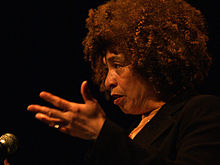
Davis opposed the 1995 Meg Human being March, arguing that the exclusion of women from this event promoted male person chauvinism. She said that Louis Farrakhan and other organizers appeared to prefer that women accept subordinate roles in society. Together with Kimberlé Crenshaw and others, she formed the African American Agenda 2000, an brotherhood of black feminists.[93]
Davis has connected to oppose the death penalty. In 2003, she lectured at Agnes Scott Higher, a liberal arts women's college in Atlanta, Georgia, on prison reform, minority problems, and the ills of the criminal justice organisation.[94]
On October 31, 2011, Davis spoke at the Philadelphia and Washington Foursquare Occupy Wall Street assemblies. Due to restrictions on electronic distension, her words were human microphoned.[95] [96] In 2012, Davis was awarded the 2011 Bluish Planet Award, an award given for contributions to humanity and the planet.[97]
At the 27th Empowering Women of Color Briefing in 2012, Davis said she was a vegan.[98] She has chosen for the release of Rasmea Odeh, associate manager at the Arab American Action Network, who was convicted of immigration fraud in relation to her hiding of a previous murder confidence.[99] [100] [101] [102] [103] [104]
Davis supports the Cold-shoulder, Divestment and Sanctions campaign against Israel.[105]

Davis was an honorary co-chair of the January 21, 2017, Women's March on Washington, which occurred the day subsequently President Donald Trump'southward inauguration. The organizers' decision to brand her a featured speaker was criticized from the right past Humberto Fontova[106] and the National Review.[107] Libertarian journalist Cathy Immature wrote that Davis'southward "long record of support for political violence in the United States and the worst of man rights abusers abroad" undermined the march.[108]
On October 16, 2018, Dalhousie University in Halifax, Nova Scotia, presented Davis with an honorary degree during the countdown Viola Desmond Legacy Lecture, equally role of the institution's bicentennial commemoration twelvemonth.[109]
On January seven, 2019, the Birmingham Civil Rights Institute (BCRI) rescinded Davis's Fred Shuttlesworth Man Rights Award, maxim she "does not see all of the criteria". Birmingham Mayor Randall Woodfin and others cited criticism of Davis's vocal support for Palestinian rights and the move to boycott Israel.[110] [111] Davis said her loss of the accolade was "non primarily an attack against me but rather confronting the very spirit of the indivisibility of justice."[112] On January 25, the BCRI reversed its decision and issued a public apology, stating that there should take been more public consultation.[113] [114]
In November 2019, along with other public figures, Davis signed a alphabetic character supporting Labour Party leader Jeremy Corbyn describing him as "a buoy of hope in the struggle against emergent far-right nationalism, xenophobia and racism in much of the democratic globe", and endorsed him in the 2019 UK general election.[115]
On January 20, 2020, Davis gave the Memorial Keynote Address at the Academy of Michigan'due south MLK Symposium.[116]
Davis was elected as a member of the American Academy of Arts and Sciences in 2021.[117]
Personal life [edit]
From 1980 to 1983 Davis was married to Hilton Braithwaite.[1] [ii] In 1997, she came out as a lesbian in an interview with Out magazine.[118] By 2020, Davis was living openly with her partner, the academic Gina Paring,[119] a fellow humanities scholar and intersectional feminist researcher at UC Santa Cruz.[120] Together, they have advocated for the abolition of police and prisons,[121] and for black liberation and Palestinian solidarity.[122]
Representation in other media [edit]
- The first song released in support of Davis was "Angela" (1971), by Italian vocalizer-songwriter and musician Virgilio Savona with his group Quartetto Cetra. He received some anonymous threats.[123]
- In 1972, German singer-songwriter and political activist Franz Josef Degenhardt published the song "Angela Davis", opener to his 6th studio album Mutter Mathilde.
- The Rolling Stones vocal "Sugariness Blackness Angel", recorded in 1970 and released on their album Exile on Main Street (1972), is defended to Davis. It is one of the band's few overtly political releases.[124] Its lines include: "She'southward a sweetness black affections, not a gun-toting teacher, not a Blood-red-lovin' schoolmarm / Ain't someone gonna gratuitous her, free de sweetness black slave, free de sweet black slave".[125] [126]
- John Lennon and Yoko Ono released their vocal "Angela" on the album Some Time in New York City (1972) in support of Davis, and a small photograph of her appears on the album's cover at the bottom left.[127]
- The jazz musician Todd Cochran, also known as Bayete, recorded his song "Free Angela (Thoughts...and all I've got to say)" in 1972.[128]
- Tribe Records co-founder Phil Ranelin released a song dedicated to Davis, "Angela'southward Dilemma", on Bulletin From the Tribe (1972), a spiritual jazz collectible.[129]
References in other venues [edit]
On January 28, 1972, Garrett Brock Trapnell hijacked TWA Flying two. One of his demands was Davis'southward release.[130]

In Renato Guttuso's painting The Funerals of Togliatti (1972),[131] Davis is depicted, among other figures of communism, in the left framework, nigh the author's cocky-portrait, Elio Vittorini, and Jean-Paul Sartre.[132]
In 1971, black playwright Elvie Moore wrote the play Angela is Happening, depicting Davis on trial with figures such every bit Frederick Douglass, Malcolm Ten, and H. Rap Brown as eyewitnesses proclaiming her innocence.[133] The play was performed at the Inner City Cultural Middle and at UCLA, with Pat Ballard as Davis.
The documentary Angela Davis: Portrait of a Revolutionary (1972) was directed past UCLA Pic Schoolhouse student Yolande du Luart.[133] [134] It follows Davis from 1969 to 1970, documenting her dismissal from UCLA. The film wrapped shooting before the Marin Canton incident.[134]
In the picture show Network (1976), Marlene Warfield's character Laureen Hobbs appears to exist modeled on Davis.[135]
Besides in 2018, a cotton T-shirt with Davis'southward face on information technology was featured in Prada's 2018 collection.[136]
A landscape featuring Davis was painted by Italian street creative person Jorit Agoch in the Scampia neighborhood of Naples in 2019.
Biopic [edit]
In 2019, Julie Dash, who is credited every bit the offset blackness female person director to have a theatrical release of a picture (Daughters of the Dust) in the Us, announced that she would be directing a film based on Davis'south life.[137]
Bibliography [edit]
Books [edit]
- If They Come in the Morning: Voices of Resistance (New York: Tertiary Press, 1971), ISBN 0-893-88022-ane.
- Angela Davis: An Autobiography, Random Business firm (1974), ISBN 0-394-48978-0.
- Joan Niggling: The Dialectics of Rape (New York: Lang Communications, 1975)[138]
- Women, Race and Class, Random Business firm (1981), ISBN 0-394-71351-vi.
- Women, Culture & Politics, Vintage (1990), ISBN 0-679-72487-7.
- The Angela Y. Davis Reader (ed. Joy James), Wiley-Blackwell (1998), ISBN 0-631-20361-three.
- Blues Legacies and Black Feminism: Gertrude "Ma" Rainey, Bessie Smith, and Billie Holiday, Vintage Books (1999), ISBN 0-679-77126-3.
- Are Prisons Obsolete?, Seven Stories Press (2003), ISBN 1-58322-581-one.
- Abolition Democracy: Across Prisons, Torture, and Empire, 7 Stories Press (2005), ISBN i-58322-695-8.
- The Meaning of Freedom: And Other Difficult Dialogues (City Lights, 2012), ISBN 978-0872865808.
- Liberty Is a Abiding Struggle: Ferguson, Palestine, and the Foundations of a Movement, Haymarket Books (2015), ISBN 978-1-60846-564-4.
- Herbert Marcuse, Philosopher of Utopia: A Graphic Biography (foreword, Metropolis Lights, 2019), ISBN 9780872867857.
Interviews and appearances [edit]
- 1971
- An Interview with Angela Davis. Cassette. Radio Free People, New York, 1971.
- Myerson, M. "Angela Davis in Prison house". Ramparts, March 1971: xx–21.
- Seigner, Fine art. Angela Davis: Soul and Soledad. Phonodisc. Flying Dutchman, New York, 1971.
- Walker, Joe. Angela Davis Speaks. Phonodisc. Folkways Records, New York, 1971.[139]
- 1972–1985
- Black Periodical; 67; "Interview with Angela Davis", 1972-06-20, WNET. Angela Davis makes her first national tv advent in an exclusive interview with host Tony Brownish, following her recent acquittal of charges related to the San Rafael court shootout.[140]
- Jet, "Angela Davis Talks near her Future and her Freedom". , July 27, 1972: 54–57.
- Davis, Angela Y. I Am a Black Revolutionary Woman (1971). Phonodisc. Folkways, New York, 1977.
- Phillips, Esther. Angela Davis Interviews Esther Phillips. Cassette. Pacifica Record Library, Los Angeles, 1977.
- Cudjoe, Selwyn. In Conversation with Angela Davis. Videocassette. ETV Center, Cornell University, Ithaca, 1985. 21-infinitesimal interview.
- 1992–1997
- Davis, Angela Y. "Women on the Move: Travel Themes in Ma Rainey's Blues" in Borders/diasporas. Sound Recording. University of California, Santa Cruz: Center for Cultural Studies, Santa Cruz, 1992.
- Davis, Angela Y. Black Is... Black Own't. Documentary picture. Independent Television Service (ITVS), 1994.
- Interview Angela Davis (Public Dissemination Service, Leap 1997)[141]
- 2000–2002
- Davis, Angela Y. The Prison Industrial Complex and its Impact on Communities of Color. Videocassette. Academy of Wisconsin – Madison, Madison, WI, 2000.
- Barsamian, D. "Angela Davis: African American Activist on Prison-Industrial Complex". Progressive 65.two (2001): 33–38.
- "September eleven America: an Interview with Angela Davis". Policing the National Torso: Sex, Race, and Criminalization. Cambridge, Ma.: Due south End Press, 2002.
- 2011–2016
- The Black Ability Mixtape 1967–1975, documentary film prominently featuring Davis in a number of rarely seen Swedish interviews, released 2011.[142]
- "Feminism and Abolition: Theories and Practices for the 21st Century" University of Chicago, 2013
- "Activist Professor Angela Davis" episode of Woman's Hour, BBC Radio 4, December three, 2014.[143]
- Criminal Queers, a fictional DIY film examining the relationship between the LGBT community and the criminal justice system, released 2015.[144] [145]
- 13th, documentary file nearly the 13th Subpoena and history of the ceremonious rights motion, released 2016.
Archives [edit]
- The National United Committee to Gratis Angela Davis collection is at the Main Library at Stanford University, Palo Alto, California (A drove of thousands of letters received by the committee and Davis from people in the U.s.a. and other countries.) [146]
- The consummate transcript of her trial, including all appeals and legal memoranda, has been preserved in the Meiklejohn Ceremonious Liberties Library in Berkeley, California.[147] [148]
- Davis's papers are archived at the Schlesinger Library at the Radcliffe Institute for Advanced Report in Cambridge, Massachusetts.[149]
- Records including correspondence, statements, clippings and other documents near Davis's dismissal from the Academy of California, Los Angeles due to her political amalgamation with the Communist Party are archived at UCLA.[133]
See also [edit]
- Africana philosophy
- Marxist feminism
References [edit]
- ^ a b "Angela Davis, Sweetheart of the Far Left, Finds Her Mr. Right". People. July 21, 1980. Retrieved Oct 20, 2011.
- ^ a b "Angela Davis At present". Los Angeles Times. March viii, 1989. Retrieved Jan 6, 2015.
- ^ "The Real Stain on Angela Davis' Legacy Is Her Back up for Tyranny". The Bulwark. January 23, 2019.
- ^ "Davis, Angela". National Women'southward Hall of Fame.
- ^ Kendi, Ibram 10. "100 Women of the Year". Fourth dimension . Retrieved June ii, 2020.
- ^ "Angela Davis: The 100 About Influential People of 2020". Time . Retrieved September 23, 2020.
- ^ "Angela Davis (January 26, 1944)". African American Heritage. National Archives and Records Administration. Retrieved January 24, 2020.
- ^ Davis, Angela Yvonne (March 1989). "Rocks". Angela Davis: An Autobiography. New York Urban center: International Publishers. ISBN0-7178-0667-7.
- ^ Aptheker, Bettina (1999). The Morn Breaks: The Trial of Angela Davis (2nd ed.). Ithaca, New York: Cornell University Press. ISBN0801485975.
- ^ Kum-Kum Bhavnani, Bhavnani; Davis, Angela (Spring 1989). "Complexity, Activism, Optimism: An Interview with Angela Y. Davis". Feminist Review (31): 66–81. doi:10.2307/1395091. JSTOR 1395091.
- ^ a b Abt, John; Myerson, Michael (1993). Advocate and Activist: Memoirs of an American Communist Lawyer. Urbana, Illinois: University of Illinois Printing. p. 273. ISBN978-0-252-02030-8.
- ^ "The Radicalization of Angela Davis," Ebony, July 1971: n.p., Mag.
- ^ Bubbins, Harry (January 26, 2018). "Angela Davis: Her Greenwich Hamlet Connections". Village Preservation . Retrieved October 21, 2020.
- ^ Barbarella Fokos (August 23, 2007). "The Bourgeois Marxist". sandiegoreader.com. Retrieved October 21, 2010.
- ^ a b c d eastward Davis, Angela Yvonne (March 1989). "Waters". Angela Davis: An Autobiography. New York City: International Publishers. ISBN0-7178-0667-vii.
- ^ Davis, Angela Yvonne (March 1989). "Flames". Angela Davis: An Autobiography. New York City: International Publishers. ISBN0-7178-0667-7.
- ^ "Angela Davis Biography: Academic, Civil Rights Activist, Scholar, Women's Rights Activist". biography. A&E Goggle box Networks, LLC. Retrieved May 6, 2015.
- ^ "Angela Davis | The HistoryMakers". thehistorymakers.org. Archived from the original on March 31, 2019. Retrieved February 7, 2018.
- ^ Mechthild Nagel (May ii, 2005). "Women Outlaws: Politics of Gender and Resistance in the US Criminal Justice System". SUNY Cortland. Retrieved October 21, 2010.
- ^ Encyclopedia of Alabama. Auburn University. Jan 8, 2008. Archived from the original on March thirteen, 2014. Retrieved April 11, 2012.
- ^ a b "Interview with Angela Davis". BookTV. October 3, 2004.
- ^ The Angela Y. Davis Reader. Blackwell. 1998. ISBN9780631203612 . Retrieved July 18, 2019.
- ^ "Jerry Pacht; L.A. Judge, Member of Judicial Committee". Los Angeles Times. April 4, 1997.
- ^ a b Wolfgang Saxon (April fourteen, 1997). "Jerry Pacht, 75, Retired Gauge Who Served on Screening Panel". The New York Times . Retrieved Baronial 26, 2019.
- ^ a b Marquez, Letisia (May v, 2014). "Angela Davis returns to UCLA classroom 45 years later controversy". UCLA Newsroom. University of California at Los Angeles. Retrieved Baronial 26, 2019.
- ^ a b "University Censured for Dismissing Angela Davis". Jet. Vol. 42, no. XLII: 9. Johnson Publishing Visitor. May 25, 1972. p. eight. Retrieved August 26, 2019.
- ^ Turner, Wallace (April 28, 2011). "California Regents Drop Communist From Faculty". The New York Times.
- ^ Davies, Lawrence (April 28, 2011). "UCLA Teacher is Ousted as Cherry". The New York Times.
- ^ "UCLA Barred from Pressing Red's Ouster". The New York Times. April 28, 2011.
- ^ "Angela Davis Biography: Bookish, Ceremonious Rights Activist, Scholar, Women's Rights Activist". biography. A&E Television Networks, LLC. Retrieved May 6, 2015.
- ^ a b c d Aptheker, Bettina (1997). The Morning Breaks: The Trial of Angela Davis. Cornell University Press.
- ^ a b "Search broadens for Angela Davis". Eugene Register-Guard. Associated Press. August 17, 1970. Retrieved September 14, 2009.
- ^ a b "Angela Davis Acquitted on All Charges". New York Times.
- ^ Treviño, Julissa (Feb sixteen, 2018). "Angela Davis' Archive Comes to Harvard". Smithsonian . Retrieved October 4, 2018.
- ^ Caldwell, Earl (April 18, 1972). "A Shotgun That Miss Davis Purchased Is Linked to the Fatal Shooting of Guess". The New York Times . Retrieved Oct four, 2018.
- ^ White, Deborah Grey; Bay, Mia; Martin, Waldo East. (December xiv, 2012). Freedom on My Mind. Bedford/St. Martin's. p. 725. ISBN978-0-312-64884-8.
- ^ "Biography". Davis (Angela) Legal Defense Drove, 1970–1972. Archived from the original on March 31, 2019. Retrieved June 14, 2013.
- ^ Charleton, Linda (April 28, 2011). "F.B.I Seizes Angela Davis in Motel Here". The New York Times . Retrieved Apr 26, 2011.
- ^ Aptheker, Bettina (Jan 21, 2014). The Morning Breaks: The Trial of Angela Davis. ISBN9780801470141. OCLC 979577423.
- ^ Davis, Angela Yvonne (March 1989). "Nets". Angela Davis: An Autobiography. New York City: International Publishers. ISBN0-7178-0667-7.
- ^ Blaney, John. 2005 John Lennon: Listen to this Book. PaperJukebox. p. 117
- ^ Sol Stern (June 27, 1971). "The Campaign to Free Angela Davis and Ruchell Magee". The New York Times.
- ^ Earl Caldwell, Angela Davis acquitted on all charges, The New York Times, June iv, 1972; retrieved August 5, 2016.
- ^ William Yardley (April 27, 2013). "Leo Branton Jr., Activists' Lawyer, Dies at 91". The New York Times. US. Retrieved May 23, 2013.
- ^ a b Seidman, Sarah. "Feminism and Revolution: Angela Davis in Cuba". American Historical Association . Retrieved March 9, 2017.
- ^ Gott, Richard (2004). Republic of cuba: A New History. New Haven, Connecticut: Yale University Printing. p. 230. ISBN0-300-10411-1.
- ^ Sawyer, Marking (2006). Racial Politics in Mail service-Revolutionary Cuba. Los Angeles: Academy of California. pp. 95–97.
- ^ Hannah, Jim (August 24, 2017). "Revolutionary research". Wright State Newsroom . Retrieved October 21, 2020.
- ^ Graaf, Beatrice de (March 15, 2011). Evaluating Counterterrorism Performance: A Comparative Study. Routledge. p. 199. ISBN9781136806551.
- ^ "Angela Davis Given Russian Peace Prize". Eugene Annals-Baby-sit. May 1, 1979. p. 120. Retrieved May 4, 2014.
- ^ "Russia Davis Prize | AP Archive". aparchive.com.
- ^ Slobodian, Quinn (December 30, 2015). Comrades of Color: Eastward Germany in the Cold War World. Berghahn Books. p. 157. ISBN9781782387060.
- ^ Farber, Paul M. (2020). A Wall of Our Own: An American History of the Berlin Wall. UNC Printing Books. p. 97. ISBN978-i-4696-5509-3.
- ^ "Unverwechselbarer "Afrolook": Angela Davis, Bürgerrechtskämpferin, erhält am 13. 09. 1972 dice Ehrendoktorwürde". Archived from the original on April 11, 2021.
- ^ Kosc, Grzegorz; Juncker, Clara; Monteith, Sharon; Waldschmidt-Nelson, Britta (Oct 2013). The Transatlantic Sixties: Europe and the United States in the Counterculture Decade. transcript Verlag. ISBN9783839422168.
- ^ Hansen, Jan; Helm, Christian; Reichherzer, Frank (Dec 12, 2015). Making Sense of the Americas: How Protest Related to America in the 1980s and Beyond. Campus Verlag. pp. 317–332. ISBN9783593504803.
- ^ Rodden, John (January 3, 2002). Repainting the Little Cherry-red Schoolhouse: A History of Eastern High german Pedagogy, 1945-1995. Oxford University Printing. p. 143. ISBN9780195344387.
- ^ Scheers, Julia (2011). A Thousand Lives: the Untold Story of Jonestown. New York: Simon and Schuster. p. 33. ISBN9781451628968 . Retrieved September 11, 2015.
- ^ Reiterman, Tim; Jacobs, John (1982). Raven: The Untold Story of Rev. Jim Jones and His People. Dutton. p. 369. ISBN978-0-525-24136-2.
- ^ "Angela Davis & the Vi Twenty-four hour period Siege". Alternative Considerations of Jonestown & Peoples Temple.
- ^ "Statement of Angela Davis (Text)". Alternative Considerations of Jonestown & Peoples Temple. Retrieved September 11, 2015.
- ^ Solzhenitsyn, Aleksandr (Oct 1976). Warning to the West. New York: Farrar, Straus and Giroux. pp. 60–61. ISBN0-374-51334-1.
- ^ Pelikan, Jiri (August 31, 1972). "An Open up Letter of the alphabet to Angela Davis". The New York Review.
- ^ Solzhenitsyn, Aleksandr Isaevich 1918-2008 (1975). Solzhenitsyn: The Voice of Freedom. Washington, DC: Washington : American Federation of Labor and Congress of Industrial Organizations. p. 32. Retrieved January 10, 2019.
- ^ Dershowitz, Alan Thousand. (1991). Chutzpah. Simon and Schuster. pp. 81–82. ISBN0671760890 . Retrieved January x, 2019.
Several days afterward, I received a recall from Ms Davis' secretarial assistant informing me that Davis had looked into the people on my list and none were political prisoners. "They are all Zionist fascists and opponents of socialism." Davis would urge that they be kept in prison where they belonged.
- ^ Holles, Everett R. (Nov 16, 1975). "Angela Davis Job Debated on Coast". The New York Times . Retrieved Feb 18, 2020.
- ^ "Ena H. Thompson Lectureship". Pomona College. April 2, 2015. Retrieved January 3, 2020.
- ^ Brooke, James (July 29, 1984). "Other Women Seeking Number 2 Spot Speak Out". The New York Times . Retrieved April 26, 2011.
- ^ "Angela Davis". Encyclopædia Britannica . Retrieved April iii, 2012.
- ^ "Angela Davis contour". UC Santa Cruz. Archived from the original on July 12, 2012. Retrieved April 3, 2012.
- ^ "Watson Professorship". Syracuse University. Archived from the original on August 31, 2013. Retrieved Apr 3, 2012.
- ^ "Scholar, activist Angela Davis to give free lecture Oct. 12". Syracuse Academy. October i, 2010. Retrieved April 3, 2012.
- ^ Ford, Olivia (May 13, 2016). "2016 Honorary Doctorate: Angela Y. Davis at Ane with Communities of Struggle". CIIS News and Events. California Found of Integral Studies.
- ^ Goodman, Walter, "Hall, at 74, withal seeks Presidency", New York Times, Nov ii, 1984.
- ^ Lind, Amy; Stephanie Brzuzy (2008). Battleground: Women, Gender, and Sexuality. Vol. 1. Westport, Connecticut: Greenwood Press. p. 406. ISBN978-0-313-34038-3 . Retrieved February 24, 2012.
- ^ "Angela Davis interviewed by Julian Bond: Explorations in Black Leadership Series". YouTube. University of Virginia. July 21, 2009. Archived from the original on Dec 11, 2021. Retrieved June 29, 2021.
- ^ Morrison, Patt (May 6, 2014). "Angela Y. Davis on what'south radical in the 21st century". Los Angeles Times.
- ^ Telusma, Bluish (July fourteen, 2020). "Angela Davis backs Biden considering he 'can exist most effectively pressured' by the left". TheGrio . Retrieved October 10, 2020.
- ^ Kelly, Kim (December 26, 2019). "What the Prison-Abolitionism Motility Wants". Teen Vogue . Retrieved April 24, 2020.
- ^ Davis, Angela (September 10, 1998). "Masked racism: reflections on the prison-industrial complex". Colour Lines. Archived from the original on March 21, 2015. Retrieved December 1, 2010.
- ^ "Freedom Struggle: Angela Davis on Calls to Defund Police, Racism & Capitalism, and the 2020 Ballot". Republic Now! . Retrieved October two, 2020.
- ^ Davis, Angela (2003). Are Prisons Obsolete?. Canada: Open Media Serial.
- ^ Davis, Angela. "Oral communication by Angela Davis at a Black Panther Rally in Bobby Hutton Park". East Bay . Retrieved April 26, 2011.
- ^ "Who Speaks for the Negro". Jean and Heard Alexander Library, Vanderbilt University. Archived from the original on March 31, 2019. Retrieved Apr 11, 2015.
- ^ "Angela Davis: 'The State of California May Have Extinguished the Life of Stanley Tookie Williams, Simply They Have Not Managed to Extinguish the Hope for a Better Globe'". Democracy Now!. December 13, 2005. Archived from the original on October 17, 2010. Retrieved October 21, 2010.
- ^ Bybee, Crystal (November 11, 2009). "Fourth Annual Stanley Tookie Williams Legacy Elevation". East Bay. Retrieved October 21, 2010.
- ^ Bernstein, Gregory (March 11, 2015). ""A Fireside Conversation on Activism" with Angela Davis". Vanderbilt Hustler.
- ^ Bromley, Anne. "Angela Davis to Headline the Woodson Constitute's Spring Symposium" Archived Apr 12, 2009, at the Wayback Machine, The Woodson Found Newsletter. Apr 2, 2009; accessed November 3, 2009.
- ^ "Davis Calls Students to Activity". Archived from the original on September xiii, 2015. Retrieved September 11, 2015.
- ^ University of Rochester Angela Davis: The Academy's Function in Educating Students to be Engaged Citizens. Archived from the original on 2 Feb 2019. Retrieved eight Oct 2020.
- ^ "Once Labeled a Terrorist, Angela Davis Talks of Recent Events". DePauw University . Retrieved June 21, 2021.
- ^ "Angela Davis making a live public spoken language". YouTube. Archived from the original on June eleven, 2010. Retrieved September 11, 2015.
- ^ E. Frances White (2001). Dark Continent of Our Bodies: Black Feminism and the Politics of Respectability. Temple University Press. ISBN978-1-56639-880-0.
- ^ "ASC Spotlight–Africana Studies". Agnesscott.edu. Retrieved Oct 20, 2011.
- ^ Nation of Change Archived Nov 3, 2011, at the Wayback Machine, nationofchange.org; accessed February 28, 2015.
- ^ "Occupy Philly address". Youtube.com. Archived from the original on Dec 11, 2021. Retrieved Dec four, 2013.
- ^ "Censure award for TEPCO Honour to be handed over in Tokyo to those responsible for Fukushima (Ethecon)". financegreenwatch.org. June 22, 2012. Archived from the original on February 21, 2014. Retrieved May 31, 2013.
- ^ "Grace Lee Boggs in Conversation with Angela Davis". Making Contact. 2012. Retrieved March 15, 2014.
- ^ "Angela Davis: Free Rasmea Odeh, political prisoner". The Detroit News. November iv, 2014. Retrieved December 18, 2014.
- ^ Jason Meisner (October 22, 2013). "Feds: Woman hid terror confidence to go citizenship". Chicago Tribune.
- ^ "Arab-American activist on trial for allegedly concealing terror role in immigration papers". The Guardian. November 5, 2014.
- ^ "Trial gear up for Jerusalem terror convict who moved to US". The Times of Israel. September 3, 2014.
- ^ "Palestinian convicted of two bombings back in U.S. court over immigration fraud". Haaretz. September 2, 2014.
- ^ Sommer, Allison (March ix, 2017). "The Palestinian Woman Bedevilled of Terror Casting a Shadow Over 'Twenty-four hour period Without Women'". Haaretz . Retrieved March x, 2017.
- ^ "Boycott, Divestment, Sanctions: What is BDS?". aljazeera.com.
- ^ Fontova, Humberto (January 28, 2017). "Humberto Fontova - Women'south March Celebrates World's Top Torturers of Women". Townhall.
- ^ Crookston, Paul (January 24, 2017). "The Top Five Worst Speeches at the Women's March on Washington". National Review.
- ^ Young, Cathy (January 21, 2017). "Women's March on Washington honors Soviet tool: Column". USA Today . Retrieved January 29, 2017.
- ^ "Angela Yvonne Davis - Convocation - Dalhousie University". Dalhousie University. dal.ca.
- ^ Reeves, Jay (January 7, 2019). "Alabama civil rights found rescinds Angela Davis laurels". Star Tribune. Archived from the original on March 31, 2019. Retrieved January vii, 2019.
- ^ Lartey, Jamiles (January 7, 2019). "Birmingham Civil Rights Institute under burn down for rescinding Angela Davis honor". The Guardian . Retrieved Jan 27, 2019.
- ^ Davis, Angela. "Statement on the Birmingham Ceremonious Rights Institute". Portside . Retrieved January 27, 2019.
- ^ "Angela Davis to receive civil rights laurels after museum reverses determination". The Guardian. January 25, 2019. Retrieved Jan 27, 2019.
- ^ "Reversing Course, Civil Rights Museum to Honor Angela Davis Afterwards All". Haaretz. Jewish Telegraphic Agency. January 25, 2019. Retrieved January 27, 2019.
- ^ Neale, Matthew (November 16, 2019). "Sectional: New letter of the alphabet supporting Jeremy Corbyn signed by Roger Waters, Robert Del Naja and more than". NME . Retrieved November 27, 2019.
- ^ Bruckner, Meredith (January 15, 2020). "Political activist Angela Davis to keynote University of Michigan's 34th almanac MLK Symposium". Click on Detroit . Retrieved October 21, 2020.
- ^ "New Members". American Academy of Arts & Sciences . Retrieved Apr 24, 2021.
- ^ Neumann, Caryn E. (July xi, 2013). "Angela Davis". Encyclopedia of Alabama . Retrieved March 24, 2021.
- ^ George, Nelson (October 19, 2020). "Angela Davis Still Believes America Tin Change". The New York Times.
- ^ "Associate Professor". USC Feminist Studies. University of California - Santa Cruz. Retrieved June 25, 2021.
- ^ Constantino, Annika (October 28, 2020). "Angela Davis, Gina Dent talk over abolition as 'a politic and a practice'". The Daily Californian . Retrieved Dec 29, 2021.
{{cite spider web}}: CS1 maint: url-status (link) - ^ "Scholar Angela Davis on Prison Abolition, Justice for Palestine, Disquisitional Race Theory & More". Commonwealth Now! . Retrieved March half-dozen, 2022.
- ^ Matteo Ceschi. "Singing What We Were to Know What We Are: The Quartetto Cetra and National History Italian TV Entertainment". Accademia.edu. Retrieved June 7, 2014.
- ^ Kurutz, Steve & The Rolling Stones. "Sweet Black Angel". Allmusic.com. Retrieved December iv, 2013.
- ^ "Sugariness Blackness Affections - The Rolling Stones | Song Info". AllMusic . Retrieved February xix, 2019.
- ^ WakeAL.com, Matt. "The Rolling Stones' 'Sweet Black Angel' was about Birmingham native Angela Davis". Tuscaloosa News . Retrieved Feb 19, 2019.
- ^ Havers, Richard (May 20, 2015). "John Lennon – Some Time In New York City". uDiscover Music. Archived from the original on July 18, 2019. Retrieved July xviii, 2019.
- ^ "Worlds Around the Lord's day - Bayeté, Todd Cochran | Songs, Reviews, Credits | AllMusic". AllMusic . Retrieved January 19, 2018.
- ^ Message From The Tribe. Tribe Records. AR 2506.
- ^ Killen, Andreas (January 16, 2005). "The Beginning Hijackers". The New York Times Magazine . Retrieved Feb 1, 2017.
- ^ "Funerali di Togliatti; Author: Guttuso Renato". MAMbo - Museo d'Arte Moderna di Bologna; Collezione on-line . Retrieved June 29, 2021.
- ^ "Detail of the painting". photoshelter.com . Retrieved February 28, 2015.
- ^ a b c "UCLA University Archives. Nerveless materials nigh Angela Davis. 1969-1982" (PDF).
- ^ a b Thompson, Howard (January 14, 1972). "Portrait of Miss Davis, Revolutionary". The New York Times. ISSN 0362-4331. Retrieved February 12, 2020.
- ^ Goldsworthy, Rupert (2007). Revolt into style: Images of 1970s Westward German "terrorists" (Thesis). "In [Network, in that location is] a figure seemingly based on Angela Davis, called Laureen Hobbs, a verbose immature Blackness Communist leader..."
- ^ Brand, Jo (Dec 24, 2018). "From vaginal eggs to sexy handmaids: Jo Brand'south feminist quiz of the year | Life and fashion". The Guardian . Retrieved December 24, 2018.
- ^ Obie, Brooke (January 27, 2019). "Sundance Exclusive: Julie Dash To Helm Angela Davis Biopic From Lionsgate". Shadow and Act.
- ^ "Joan Little: The Dialectics of Rape". Ms. Archived from the original on January 30, 2018. Retrieved April 27, 2018.
- ^ "Smithsonian Folkways Recordings".
- ^ "Interview with Angela Davis". Black Journal . Retrieved July 7, 2021.
- ^ "Interview with Angela Davis | The 2 Nations of Black America | Frontline". pbs.org . Retrieved April 27, 2018.
- ^ "The Blackness Power Mixtape 1967–1975". imdb.com. April 1, 2011.
- ^ "Activist Professor Angela Davis", Woman'south Hour, BBC Radio 4, December 3, 2014.
- ^ "Criminal Queers Screening & Conversation - Henry Art Gallery". henryart.org.
- ^ "The Filmmakers Behind 'Criminal Queers' Explain Why "Queer Liberation is Prison Abolition"". In These Times.
- ^ National United Committee to Free Angela Davis (1970–72). "National United Committee to Free Angela Davis records, circa 1970–1972". searchworks.stanford.edu . Retrieved March 2, 2017.
- ^ "Meiklejohn Ceremonious Liberties Institute | Using the Law | Bancroft Library". mcli.org . Retrieved March 2, 2017.
- ^ The Bancroft Library, University of California, Berkeley. "Publications of the Meiklejohn Ceremonious Liberties Institute". bancroft.berkeley.edu. Archived from the original on March 24, 2019. Retrieved March two, 2017.
{{cite web}}: CS1 maint: multiple names: authors list (link) - ^ Hong, Sarah J. (February 14, 2018). "Angela Davis Donates Papers to Schlesinger Library". radcliffe.harvard.edu. Radcliffe Institute for Avant-garde Study. Retrieved February 27, 2018.
Further reading [edit]
Popular media
- "Interview with Angela Davis". Frontline. PBS.
- Davis, Angela (Guest). "Resisting the Prison Industrial Complex". Democracy Now. Round table discussion.
- "Attacking the Prison house Industrial Circuitous". Time. 1998. Archived from the original on Baronial 17, 2000. Chat-room users' interview with Davis.
- "Angela Davis". Harvard Gazette. March xiii, 2003. Archived from the original on Dec 23, 2005. Retrieved December xiii, 2005.
- "Practical Activism Briefing in Santa Cruz". indybay.org. October 27, 2007. . Audio recording of Davis.
- Younge, Gary (November eight, 2007). "We used to think there was a black community". Guardian. Interview.
- "Angela Davis on the 40th Anniversary of Her Abort and President Obama's First Two Years". Democracy Now!. October xix, 2010. Video interview.
- "Interview with Angela Davis". C-Span. In Depth. October 3, 2004.
- Roberts, Steven V., "Angela Davis: The Making Of a Radical", New York Times, August 23, 1970.
Books
- Davis, Mike; Wiener, Jon (2020). Set the Night on Burn: 50.A. in the Sixties. New York: Verso Books.
Main Sources
- Donald Kalish papers, Box 4 and Box seven. UCLA Library Special Collections.
External links [edit]
- Angela Davis at AllMovie
- "Davis quotations". Blackness History Daily.
- Appearances on C-SPAN
- Angela Davis at IMDb
- "Angela Davis Biography, The Civil Rights Struggle, African American GIs, and Germany". aacvr-germany.org. Archived from the original on May 3, 2011. Retrieved January 24, 2011.
- "Angela Davis". Encyclopedia of Alabama. Archived from the original on March xiii, 2014. Retrieved March 4, 2009.
- "Angela Davis Ephemera Collection, Westward.S. Hoole Special Collections Library". University Libraries Division of Special Collections, The Academy of Alabama.
- "Film clip, Davis speaking at Florida A&M University's Blackness History Calendar month convocation". Florida Memory. 1979.
- The New York Times archive of Davis-related articles, nytimes.com;
- Angela Y. Davis Papers, 1937–2017 MC 940. Schlesinger Library, Radcliffe Establish, Harvard Academy, Cambridge, Mass.
- Angela Y. Davis Collection of the Schlesinger Library A/D260. Schlesinger Library, Radcliffe Institute, Harvard Academy, Cambridge, Mass.
Source: https://en.wikipedia.org/wiki/Angela_Davis
0 Response to "Ben Davis National Museum of Women in the Arts"
Enviar um comentário